
Gogo Galileo HDX and FDX: Half? Full? Or just right?
November 21, 2025
Gogo Galileo is bringing the high-speed, low-latency power of Eutelsat OneWeb’s low-earth orbit (LEO) satellite constellation to business aircraft globally, regardless of their size. Key to the service offering is the ability to select from a choice of two antennas, the Gogo Galileo HDX and Gogo Galileo FDX Ku-band antennas.
Our mission is to provide our customers with the ability to customize their connectivity offering to best suit their specific needs, which is the motivation behind offering two variants of the electronically steered antenna (ESA) as part of our multi-band, multi-orbit portfolio.
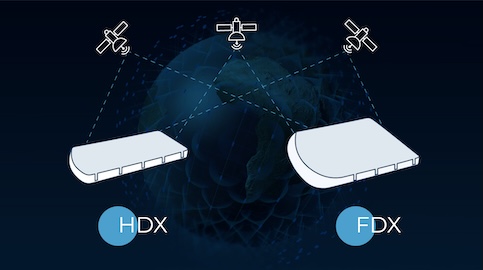
So, what’s the difference?
Our engineers and designers will inform you that the HDX is a half-duplex antenna, which means it comprises a single electronically steered array (ESA) that constantly and seamlessly switches between transmit and receive modes quickly, enabling the transfer of data to and from a satellite. This allows the HDX assembly to be very compact while still providing a great experience.
We like to define experience based on what you can do with a connection rather than ‘how fast’ it is. Speeds vary continuously, and any speed test is only good for the moment of the test. Our HDX is designed to enable six or more passengers to simultaneously video call, live stream, use data-hungry apps, and email and corporate networks. It effectively delivers an on-the-ground experience at altitude.
Those same technical experts explain that the Gogo Galileo FDX is a full-duplex antenna. This means it has two arrays, one dedicated to transmission and one to reception, which effectively widens the data pipe into the aircraft. By allowing data to be transmitted and received simultaneously, more data-intensive applications can be optimized by more passengers with even lower latency. The FDX can be used independently to deliver consistent, global connectivity to mid-sized to super-sized jets, allowing multiple passengers to also stream TV, hold video calls, game, or stay in touch with friends, family, and colleagues.
You may be thinking that ‘H’ for ‘half’ is ‘not as good’ as ‘F’ for ‘full’, or that HDX is ‘not as good’ as FDX because it is slower. Is the HDX glass, in fact, half full? In typical engineer fashion, our technical experts will tell you that the HDX glass is exactly full enough. In a world where consumer electronics develop very quickly and ‘speed’ is often the yardstick against which improvements are measured, equating ‘slower’ to ‘not as good’ and comparing ‘half’ to ‘full’ superficially makes sense, but there is much more to the Gogo Galileo story.
It is helpful to consider Gogo Galileo FDX as comprising a pair of HDX arrays. It is therefore larger and heavier than HDX – it measures 30 inches in length, is slightly under 25 inches wide, and weighs 45 pounds, compared to 24 inches, almost 12 inches, and just under 22 pounds for HDX.
The engineering and physics challenges inherent in connecting a fast-moving aircraft with a satellite dictate that an antenna must be placed on top of the fuselage (or in some cases on the tail). On smaller aircraft the space for such a mounting is likely to be limited and that’s where Gogo Galileo HDX comes into its own. A smaller aircraft inevitably has relatively few passenger seats, and even at full load, Gogo Galileo HDX will provide each one of those passengers with a connectivity experience that matches digital performance at home or in the office; in this context, the compact, lightweight HDX antenna is optimized for airframe size and happy, connected passengers.
A larger aircraft with a fuselage and cabin space that can carry more passengers will warrant a Gogo Galileo FDX. Now the size-experience equation makes sense for the heavier antenna, as it delivers sufficient speed and bandwidth to satisfy the demands of a larger cohort of streaming, video-calling, and conference-calling passengers. The technology is essentially the same, the experience similar, and the delivery optimized.
Operators of larger aircraft are, of course, free to choose the smaller antenna should their regular passenger loads or usage fall within its still-generous limits. Sufficiently large aircraft also have the space to mount either antenna in addition to a terminal serving a geostationary orbit (GEO) satellite constellation, providing possibilities for redundancy, further optimized performance, and continued connection regardless of national airspace restrictions. A Gogo Galileo FDX terminal also enables operators to assign the bandwidth to specific aircraft zones, certain passengers, or to support particular tasks such as aircraft health monitoring, while leaving the second antenna – be it an ESA or tail-mount variant – to support the connectivity demands of the passengers.
There are other significant benefits to the Gogo Galileo HDX and Gogo Galileo FDX portfolio. The terminals have been specifically designed to meet the unique needs of business aviation and military/government customers. They’ve not been repurposed from technology that serves commercial airlines, cruise ships, or recreational vehicles. The construction has taken into consideration the complete spectrum of business aviation operating parameters and the need to protect an owner’s investment. They’re also certified by the regulatory bodies to confirm they are fit for purpose. A key benefit is that we’ve future-proofed the technology, which means that once installed, the antennas are designed for long-term use and can be upgraded as needed with minimal downtime.
In our engineer’s world, it is not a case of the glass being half full; it's about having the connectivity glass overflowing. That’s what the Gogo Galileo antennas are designed for: to ensure exceptional, optimized performance globally.
Learn more about the Gogo Galileo HDX and FDX antennas. Download the data sheet here.