
SDG and Gogo, the same, but different...
January 13, 2026
If you are among Gogo’s business aviation customers, you might be unaware of the SD Government, SDG, brand. Likewise, our government customers are typically unfamiliar with the Gogo brand, which is why Gogo Holdings, our parent company, retains two brands, each trusted after many years for serving its respective market.
On the outside at least, there is often little noticeable difference between a Global or Gulfstream modified for a special mission, like intelligence, surveillance, and reconnaissance (ISR), and the same aircraft equipped as a regular business jet. There is even less to choose between an ACJ or BBJ flown as a head-of-state or government VVIP transport and the same aircraft in corporate service.
Yet connectivity for the former falls firmly under our remit at SD Government, and the latter to Gogo. So, what’s the difference between SD Government and Gogo? Why do we need both divisions when the aircraft the customers operate are not so very different?
Despite appearances, there are significant differences in how the customer operates, not only in terms of day-to-day missions, but also in procurement. Our business with the US Government, for example, is fundamentally different from Gogo’s commercial business. The government work is subject to more extensive bureaucracy, differing regulations, highly structured procurement processes, strict accountability, unique contract terms, and the need for specific certifications and compliance with certain Acts. Among many other requirements, therefore, SDG must adhere to the strictures of the Buy American Act and respect the Government’s right to unilaterally change contracts.
Gogo’s work in business aviation is not so strictly bound. Market demand is the major driver, resulting in a more flexible and dynamic process, free from the strictly regulated systems of government contracting designed to ensure fairness, transparency, and the achievement of national goals when public money is spent.
Our customers include head-of-state, air mobility and ISR operators, as well as civilian agencies flying challenging missions that range from aeromedical evacuation through to law enforcement to maritime patrol. For them, resilient, uninterrupted connectivity is critical to mission success. Like Gogo’s business aviation customers, they also value our 24/7/365 expert support and strict cybersecurity, but with additional requirements for encrypted communications and compliance with government standards, including the Federal Risk and Authorization Management Program (FedRAMP) and International Traffic in Arms Regulations (ITAR).
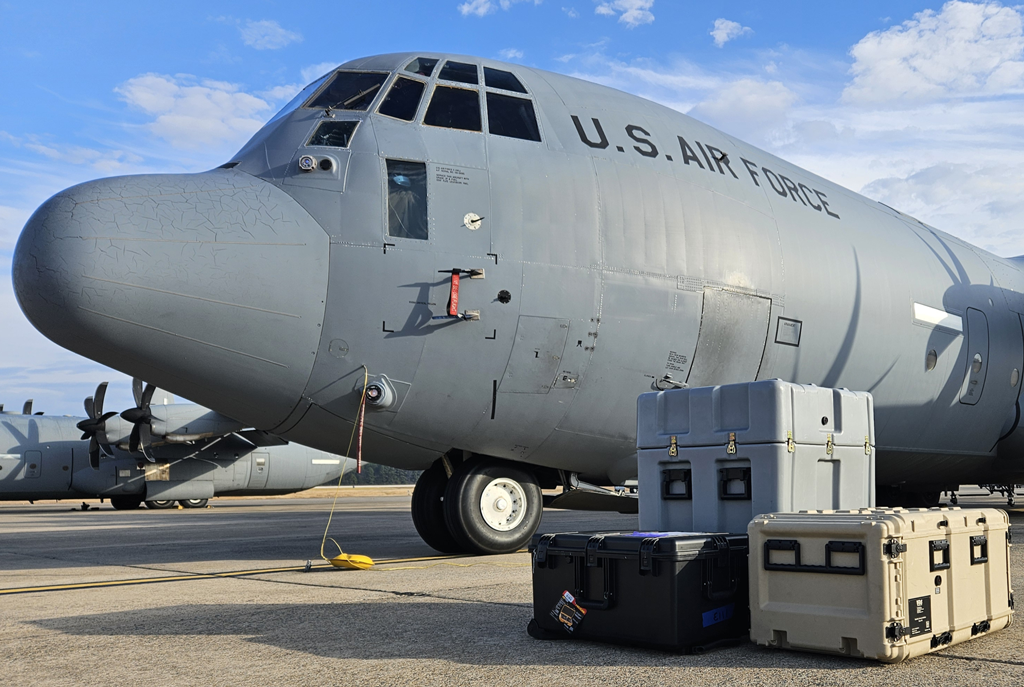
Gogo’s business aviation customers are more likely to focus on enhancing the passenger experience, satisfying their productivity needs, supporting entertainment and global connectivity goals with seamless, consistent service. Typically, they want their connectivity integrated into the cabin management system and solutions including voice, video streaming, VPN, and a myriad of apps supporting everything from stock broking to design.
Depending on the mission, government crews also want apps and connections that help them remain productive in the air. Still, they may also need an encrypted, rock-solid ‘pipe’ that enables them to stream live video back from an aircraft-mounted sensor to a distant command center. When that imagery informs critical decisions and lives are at stake, then defense operators rely upon SDG’s hardened, secure, and encrypted connectivity solutions, wherever in the world, and even in contested regions.
Just like the Gogo services, the SDG solutions are network-agnostic. We work directly with our customers to design the most efficient and cost-effective solution to their needs, sometimes with coverage from government-dedicated satellites. We also work closely with our Gogo colleagues on product development, building specific applications or hardware, or modifying existing capabilities to meet government or Department of Defense requirements; we created SD Pro 2.0, based on Gogo’s well-established SD Pro communications and operations platform, specifically for the US Air Force Air Mobility Command.
Commercial life cycles also differ greatly. It can take literally years to sign a government agreement as the strict tender and procurement processes play out. Gogo customers have greater flexibility, invariably wanting the hardware fitted and the software activated within much shorter time frames. The length of contracts often reflects the sales lifecycle; government contracts may last up to five years, while Gogo customers usually need to consider ownership lifecycles before committing to lengthy agreements. The sales, administrative, and signing processes are very different, which is why the teams in each division have very specific skill sets.
While there are technologies in common between business aviation and government communications, the differences between the two markets have led us to develop a specialist SDG team, comprising military veterans and professionals with extensive government backgrounds. Their experience is essential. They speak the same language as the customer, helping us better understand missions and requirements, and building trust. Our Gogo team may also have military backgrounds, but has invariably spent time in telecommunications, airlines, or piloting private aircraft. The key similarity is that they boast a rich breadth of experience to support their customers and are trusted to deliver the right connectivity product.
Trust is crucial to both sectors, but perhaps even more so for defense operators. This is why the SDG business is physically and digitally separated from Gogo’s commercial business in a ‘fenced-off enclave’; in this way, access to sensitive data is carefully controlled. We are proud that many of our employees hold security clearances, and that our office in Melbourne, Florida, has ‘secret’ facility clearance.
At SDG, we are all about compliance, security, mission assurance, and long procurement cycles, while Gogo's customer focus is on experience, speed, flexibility, and service-driven relationships. The difference ends there; no matter which customer segment we are working with, we always abide by our mission to deliver professional, impartial, and reliable services, supported by purpose-built technology, to deliver consistent, high-speed connectivity beyond expectations.